Ask anyone who’s worked civil in Brisbane for a while and they’ll have a story. Usually it starts the same way. The plans looked fine. The locator had been out. Paint on the ground, everyone happy. Then the bucket went in a bit off the line and came up with a bit of orange conduit hanging off one tooth.
One that comes up a lot around here is a driveway crossover job in an older street in the inner north. Timber and tin houses, footpaths that have been dug up and patched a dozen times since the seventies. The plans showed a water main and a power cable on the other side of the road. What they didn’t show was an old Telstra lead-in running at maybe 250 mm, right through where the new crossover was going. The excavator found it in about ten seconds. Nobody got hurt. Three houses lost their phone and internet, the builder got the bill, and the job sat idle for most of a week.
That’s the mild version. A lot of the work we do comes down to making sure the bad version never happens.
What underground service strikes actually are
An underground service strike is any time you hit something buried while you’re digging. Gas, water, sewer, stormwater, power, fibre, old copper phone lines, traffic signal cables, street lighting. Plus all the private stuff running from a meter to a shed, a pool pump or a granny flat out the back.
Some strikes are nothing much. You nick an irrigation line, patch it and move on.
Others are a very bad day. Put a bucket through a high voltage cable and the operator’s lucky to walk away. Crack a gas main and the street gets cleared, emergency crews show up, and someone from the regulator wants to see your paperwork. Cut a big fibre trunk and you can knock a medical centre, a shopping strip or half a suburb offline. Repair costs on that kind of strike can run into the tens of thousands before anyone starts talking about the outage itself.
Then there’s the cost nobody puts in the incident report. The site gets shut down. The crew stands around on wages. The program slips. Insurers start asking questions. And word gets around among the people who hand out the next contract.
Why strikes keep happening on Brisbane sites
Everyone checks the plans, so why do underground service strikes still happen? Mostly for boring reasons.
The plans show where someone thinks the service is. Lodge a Before You Dig Australia enquiry every time. It’s free and it’s the starting point. But treat what comes back as a guide, not a survey. Some of those records go back decades. Roads have been widened, footpaths moved, kerbs rebuilt after floods. A cable drawn along the property boundary might sit under the middle of someone’s driveway now.
Depth is often anyone’s guess. Plenty of plans don’t show depth at all. Even when they do, it was measured when the service went in. Brisbane blocks get cut, filled and regraded all the time, especially on the hilly streets. Something that started 900 mm down could be 400 mm down today.
Private services usually aren’t mapped. Once you’re past the meter or the boundary, it’s generally the owner’s responsibility. That means power to the shed, a gas line to the barbie or pool heater, or an old water service everyone swears is disconnected. It often isn’t.
Locating has limits. A good locator is worth every dollar. But plastic pipes don’t always show up, deep services get vague, and a crowded footpath in Fortitude Valley or South Brisbane can throw confusing signals. Paint on the ground tells you where to start looking. It doesn’t tell you exactly where the thing is.
Our ground doesn’t make it easy. A lot of Brisbane sits on heavy reactive clay, with weathered rock not far underneath in places. After a big summer storm the clay turns to soup. In a dry spell it goes hard as brick. Operators push harder in tough ground, and that’s when mistakes happen.
Machines can’t feel what they’re hitting. A 5-tonne excavator can’t tell the difference between stiff clay and a poly gas pipe until it’s too late. Even a careful operator with a mud bucket can tear a cable sheath and never know.
Put all that together and you’ve got uncertain plans, uncertain depths, unmapped private lines and a digging method that gives no warning. That’s how most strikes happen.
Where vacuum excavation fits in
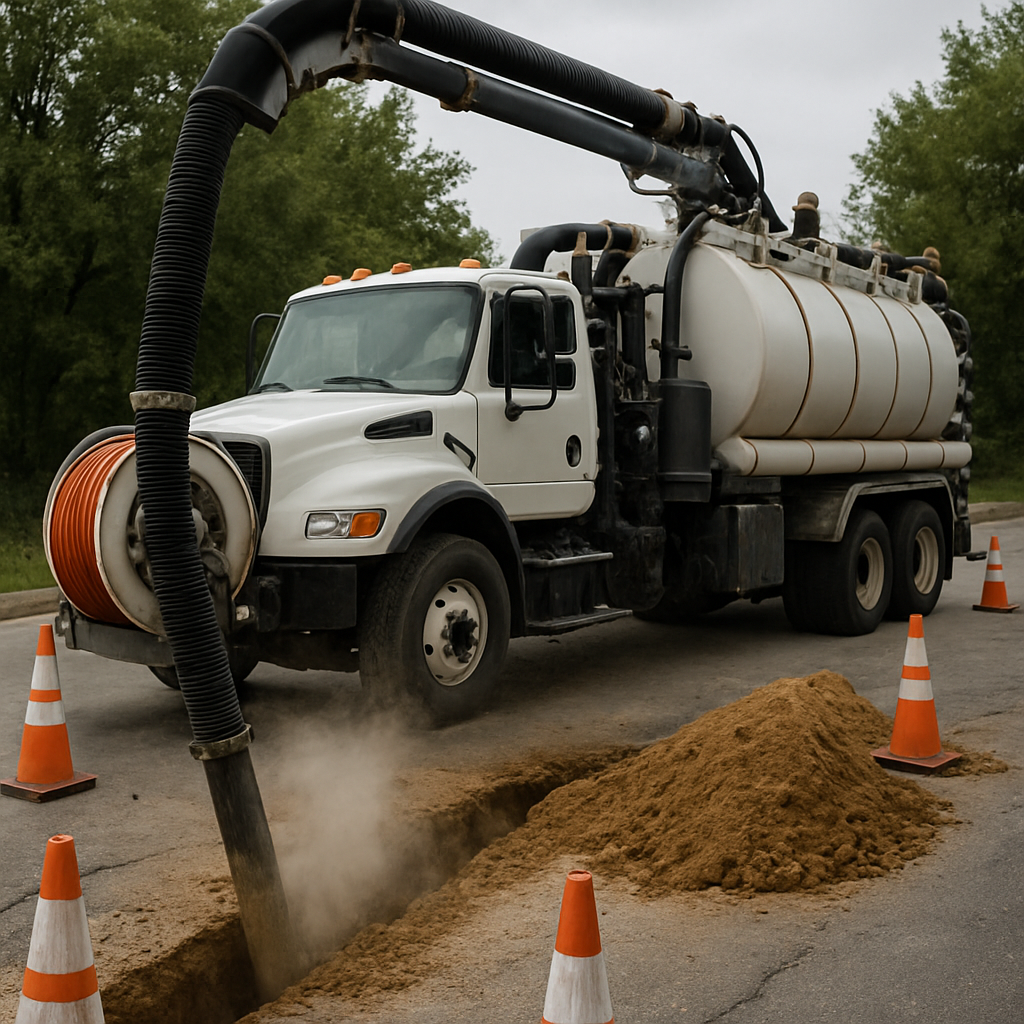
Vacuum excavation, also called non-destructive digging or NDD, breaks up the soil with pressurised water and sucks it up a hose into a tank on the truck. Some units use air instead of water. No bucket, no teeth.
Hydro excavation for underground utilities works because water at the right pressure cuts through soil but washes around a pipe or cable instead of through it. As the hole gets deeper, the service just shows up. You can see it. You can measure it. You can work out what it is and which way it’s running.
That’s really all it is. You stop guessing.
Potholing for underground services
This is the everyday work. Before you design a new service run, bore under a road, sink piers or pour a slab, you dig small holes to prove what’s actually down there. Potholing for underground services with a vac truck is quick and tidy. In decent ground, a good operator can open a pothole in a footpath in well under an hour, and you walk away with a real depth and a real position, not a line on a drawing.
Designers love this. So do drillers. Nobody wants to find out halfway through a bore that the gas main is 300 mm higher than the plans said.
Excavation near underground services
Say you’re running new conduit right next to an existing water main. Digging that close with a machine is asking for trouble. With vacuum excavation around underground utilities, you expose the main first, then dig your trench knowing exactly how much clearance you’ve got.
Many asset owners actually require non-destructive methods within a set distance of their assets. Energex, Urban Utilities, the gas networks and the telcos all have their own conditions. They usually come attached to your Before You Dig plans. Read them. They’re often very specific about how close you can get with a machine and when you need to switch to hand digging or vac.
Busy inner-city streets
Footpaths in the CBD and older suburbs are packed. Services stacked on top of each other, crossing at strange angles, some live, some dead, some nobody’s sure about. There’s often no room for an excavator anyway. The vac truck parks on the road, the hose goes across, and the crew digs a neat hole without wrecking the footpath or blocking pedestrians all day.
Jobs where the plans are wrong or missing
This is where vacuum excavation for utility exposure really pays for itself. Old industrial sites near the river. Heritage buildings. School grounds and hospital campuses that have been added to bit by bit for fifty years. Acreage out past the suburbs with years of DIY trenching. When nobody can tell you with any confidence what’s in the ground, uncovering it slowly and visually is the only sensible way to go.
You also find stuff nobody expected. Old brick drains. Cables marked redundant that are very much live. Asbestos cement pipe. With vac, you usually see it before you damage it, which gives you time to stop and sort out what to do next.
Underground cable damage prevention is about more than the truck
Here’s the part that gets lost when people sell vac trucks as a magic fix.
Vacuum excavation reduces the risk. It doesn’t remove it.
High pressure water can absolutely damage a service. Run the pressure too high, or hold the nozzle too close to a poly gas line or an old cable with brittle sheathing, and you’ll cut straight through. Good underground cable damage prevention comes down to the operator. They need to set pressure for the soil, keep the lance moving, hold the right distance and ease right off as they get near where a service should be.
That feel takes time. It comes from hundreds of holes, not a twenty-minute walkaround at the depot.
And the truck doesn’t replace the basics of safe excavation around utilities:
- Lodge a Before You Dig Australia enquiry and actually read what comes back
- Get a competent locator to mark services on site where needed
- Ask the property owner about private services, and check for them
- Have a proper SWMS that covers the specific services on your job
- Set up exclusion zones around the truck and hose
- Follow the asset owner’s conditions, including any supervision or permit requirements
- Keep to your obligations under Queensland work health and safety law
Then record what you find. Photos, depths, offsets, marked-up drawings. If you don’t, the next crew is back to guessing.
The way to think about it: underground utility damage prevention is a process, and vac is the last step in it. The plans and the locating tell you where to look. The vac truck lets you confirm it without breaking anything.
Is it worth the money?
People sometimes balk at the hourly rate compared to a small excavator. Fair enough. On paper, the excavator’s cheaper.
But look at what you’re comparing. One fibre strike can wipe out the savings from a year of cheap digging. A gas strike can shut a site for days. An HV strike can kill someone. A few hours of vac work to expose everything in the danger zone starts to look like cheap insurance.
Plenty of good contractors use both on the same job. Vac first, to find and expose services where the risk is. Then the excavator comes in for bulk digging once everyone knows where it’s safe. Each machine does the job it’s good at.
Choosing vacuum excavation in Brisbane
Not every job needs a vac truck. If the ground is well mapped, the services are deep and clear and you’re nowhere near anything critical, a careful machine dig might be fine.
But if the plans are old or patchy, you’re working in a crowded footpath, there’s gas or high voltage nearby, a fibre trunk runs through the site, or nobody can tell you for sure what’s down there, that’s when you want it.
If you’re looking at vacuum excavation in Brisbane, or non-destructive digging Brisbane-wide, ask a few honest questions before you book anyone. How long have the operators been doing this? Have they worked near the kind of services on your job? Will they give you photos and depths of what they expose? Do they handle slurry disposal properly? A crew that answers those easily is usually a crew that’ll dig carefully.
The rule I’d go by is pretty simple. The less you know about the ground, and the worse it’d be to get it wrong, the more sense it makes to dig in a way that lets you see what you’re digging into.
Plan it. Get it located. Put a competent operator on the truck. Then dig like you might be wrong about where everything is, because some days you will be.